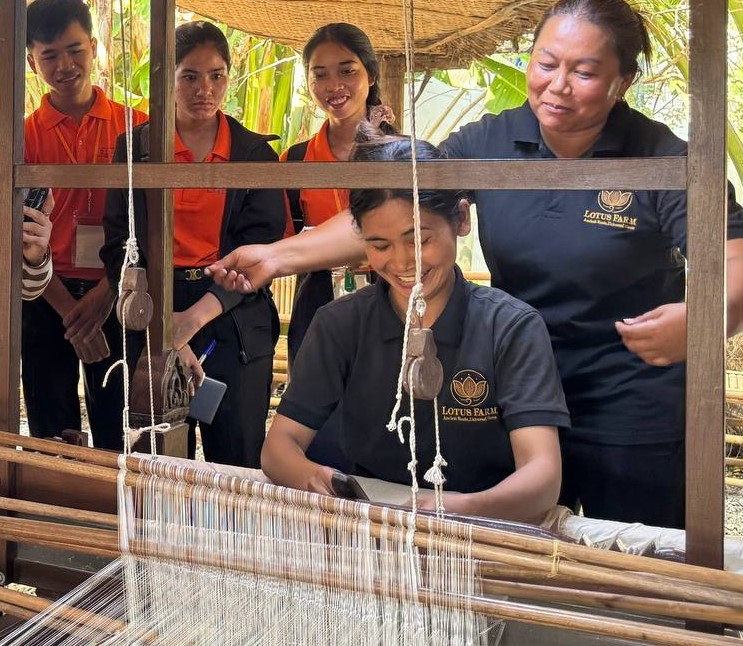
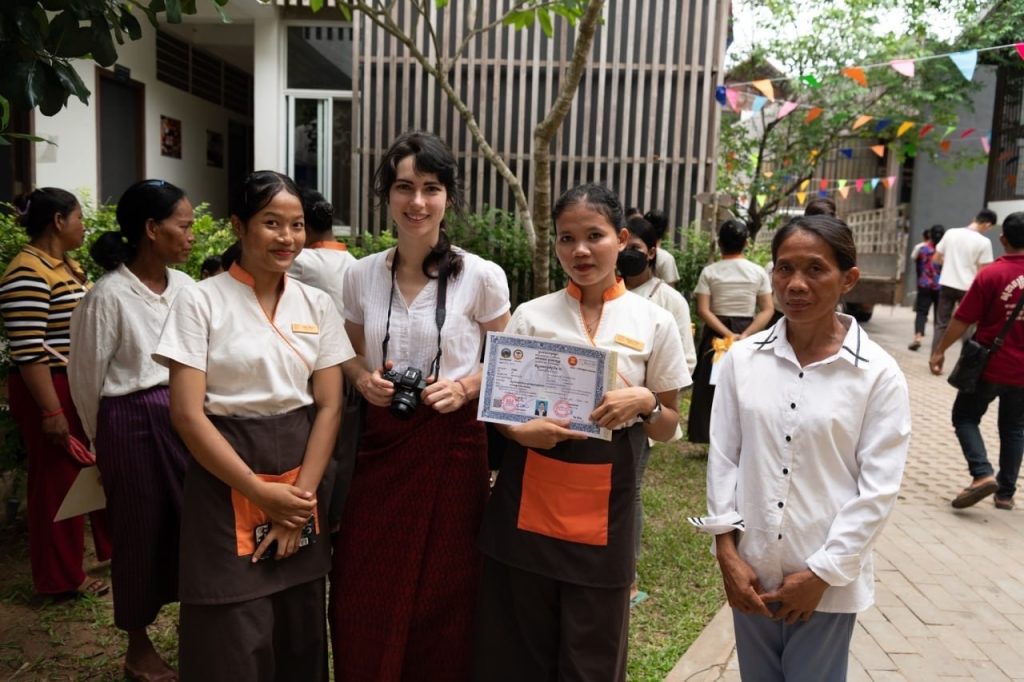
For the past two years, Lucie Bondu has been working as a Communications Manager in Sala Bai, Cambodia. At the end of her assignment, she decided against flying home, opting instead for cycling and a more leisurely pace. Her guiding thread: clothing. A seamstress by trade, she set out to document Asian textile traditions in the face of polluting fast fashion. Exploring the intersection of ancestral craftsmanship and environmental concerns, she will create a photo-documentary book that seeks to understand the roots of the present in order to weave a more sustainable fashion industry.
You've just finished your VSI mission in Cambodia. What's your state of mind as you approach this new adventure, the return trip by bike?
Indeed, my mission is coming to an end soon, and I must admit that, for the past few months, I've been mostly preoccupied with all the projects I need to finalize before leaving Sala Baï. I hadn't really imagined what would happen next until one Friday evening, as I was leaving work, I received a call from Romain. (Southeast Asia Regional Coordinator for The Guild) informing me that my somewhat crazy project had been selected to be the winner of an adventure grant!
Your project blends travel, photography, textiles, and environmental commitment. How did the idea of exploring traditional Asian textile techniques come about?
My project blends many things that have been on my mind for a while. I enjoy trying my hand at everything, and for the past two or three years, I've taken up sewing. I quickly started visiting fabric markets in Cambodia and discovered the abundance of traditional clothing and patterns. But where do these fabrics come from today? How are they made? Most aren't handwoven, nor are they made of pure silk. And we mustn't forget that the textile industry is one of the country's leading economic sectors, primarily export-oriented, and particularly polluting. So, on the one hand, the tradition of weaving, the meanings behind each motif, seem fascinating and sublime to me; on the other hand, it seems important to confront this subject with the reality of current issues, especially environmental ones (another issue close to my heart). Added to these questions, of course, is the dimension of travel and adventure, which continues to thrill me. I've always told myself that if I were to travel again, it would be by bicycle, so I could have my own mode of transport without leaving a carbon footprint. And besides, cycling is intriguing and conducive to meeting people.
As a seamstress, what do you hope to discover from the artisans you will meet? Is there a particular question that will guide your investigation?
There are many aspects I would like to investigate:
- Traditional techniques and materials that we could "rediscover" today. For example, a farm in Siem Reap produces fabrics from lotus fibers. I would like to investigate ancestral knowledge to find potential alternatives to our current practices, from basic materials to dyeing and weaving.
- The history and cultural meanings behind the fabrics and patterns.
- Current initiatives already launched that try to reintroduce some ecology into the textile industry.
I would also like to begin by conducting a review of the existing literature and some preliminary interviews to refine the angle of my investigation.
You want to explore the links between ancestral craftsmanship and fast fashion. In your opinion, what can these traditions teach us to build a more sustainable fashion industry?
I may have already touched on this, but I believe that traditional craftsmanship can teach us to use more sustainable materials and less environmentally harmful production methods. Furthermore, by rediscovering the value of each object and the meanings behind colors and patterns, I would also like to re-examine our relationship with clothing and fashion.
Has your volunteer mission transformed your perspective on your profession and guided the development of this project? How will this experience support you on your journey?
I'm the communications manager at a vocational training school. Being on the ground has been incredibly enriching and inspiring: I see and support every new project, the students' progress throughout the year and beyond. It's transformed the way I do my job. The challenge has been to convey my enthusiasm, to be able to powerfully summarize the essence of a program that is alive and must be experienced. The communication and marketing surrounding Sala Baï must reflect the project's authenticity, its joy, and its sense of community. This challenge will always be present on the road.
If you had to inspire other volunteers to dare to undertake a slightly crazy project after their mission, what would you tell them?
I haven't yet realized my project, but the fact that I received this grant proves that you never know! If you have a crazy idea that's been brewing in your head, don't hesitate to put it down on paper; sometimes that's how it comes to life unexpectedly.