
The Amazon. This immense carpet of greenery, glimpsed from an airplane window. Exotic trees. Magnificent birds. The vivid tale of mustachioed explorers, lost, adrift, in a reverie perhaps as infinite as the canopy above their heads.
Those who actually set foot there discover, however, that the Amazon is not just a forest. It is a world where rivers serve as roads, where communities have lived in harmony with nature for generations, but where a decision made thousands of kilometers away can determine the fate of a tree, a village, or an entire species..
It is in this world that sixteen volunteers, supported by the Guild, have chosen to dedicate themselves through the V-Amazonie program of France Volontaires. Scientists, engineers, communications professionals, and recent graduates, they have left behind their daily routines and preconceived notions to travel to Peru, Colombia, Bolivia, Ecuador, and Brazil. Their mission: to contribute to the preservation of the world's largest rainforest.
Serving Amazonian wildlife
In Iquitos, Peru, Martin de Guilhem works at the Centro de Rescate Amazónico, a center dedicated to the care and rescue of animals harmed by human activity. Immerse yourself in the daily life of a volunteer in the heart of the rainforest, where life heals itself.
When the cards come to life
For three months in 2023, Diego Ivorra dedicated his internship to the topic of housing in Puerto Guzmán, Colombia. At the end of his internship, he was familiar with the statistics, maps, and territorial assessments. He had studied the needs of the population and imagined solutions to improve their housing. Yet, he had never actually been there.
«I had listened to hours of interviews, created dozens of maps, and studied vast databases on the socio-economic conditions of the inhabitants,» he recounts. He thought he knew everything about a place he didn’t know. The V-Amazonia program allowed him to go there. «I was able to visit this place, talk with the inhabitants, and walk among the trees of the Itarka Nature Reserve.»
And these trees have overflowed the Excel spreadsheets. Statistics have taken on a human face. Ideas have confronted reality. Today, Diego is developing construction solutions using local Amazonian wood to sustainably improve the housing of communities. He knows the results won't be immediate. But he wants to build the future: "I hope that one day I'll receive photos of houses built or improved with native Amazonian wood, ensuring good living conditions for the inhabitants of Puerto Guzmán."«
Head in the clouds
In Bogotá, Charlotte Audeoud is trying to answer the question: how do climate change and deforestation influence extreme weather events? The question is far from theoretical; Mocoa is tragic proof of this. In 2017, the Colombian city suffered deadly floods that caused more than 300 deaths. "Measuring the role of human activities in this type of disaster shows that it's not solely a natural catastrophe," she explains. At the University of Rosario, Charlotte is working on hydroclimatic models whose results can inform public policy and strengthen early warning systems.
She also visits schools to talk about the Amazon rainforest and biodiversity. It was there that she discovered the wisdom of children: the most naive questions are often the most relevant. How do trees make it rain? What will happen if the forest disappears? How can we protect it? These encounters give Charlotte's mission its full meaning. When she talks about the defining moments of her experience, she doesn't mention a scientific discovery. She talks about Juan. "Passionate about meteorology, but also about history and literature, he works as a research assistant with the same team as me. Over time, a true friendship has developed despite the differences in language and background."«

Charlotte Audeoud at the University of Rosario
What the forest teaches us
Lucas Blauwart works in Peru with Envol Vert. A tropical forestry engineer by training, the Amazonian flora and fauna had long been a part of his dreams. Today, he supports the development of sustainable economic activities in sixteen villages and indigenous communities: beekeeping, ecotourism, forest seeds, and the processing of forest products. The objective is simple in principle, ambitious in its execution: a living forest must be a more valuable resource than a dead one. "These economic activities generate income quickly and sustainably." Through his travels to isolated communities, Lucas sees firsthand the impact of these projects. "When I went to the native communities in Ucayali, where living conditions are difficult, I saw that the work being done had a real impact." Lucas takes away one lesson from the mission: a protected forest often allows people to live with dignity.
And then there are the unexpected rewards, like the impromptu encounter with a rainbow boa. Yes, they exist; no, it's not the name of a 1970s psychedelic rock band. It's simply one of the countless wonders that the forest reveals to those who take the time to explore it.
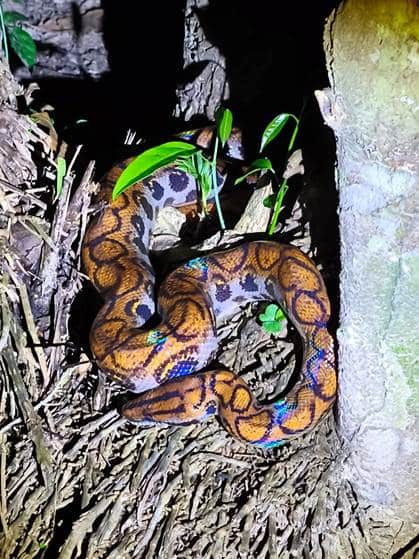
Rainbow Boa in Ucayali
Following the rhythm of ancient knowledge
Ornella Laurenti had already embarked on a first journey. In 2019, a Civic Service Volunteer placement in Argentina, between a biosphere reserve and a museum of archaeology and anthropology, had opened a door for her. It was a place of commitment where one learns as much as one teaches, where one works without ever ceasing to discover. Since then, she has had a series of experiences in Ecuador, Colombia, and French Guiana, all natural extensions of the same desire: to combine fieldwork, research, and commitment in South America. The International Solidarity Volunteer (VSI) program then became an obvious choice, almost a continuation.
It was in Iquitos, Peru, at the IIAP, that she found the setting for this new mission: "Valuing Traditional Knowledge Related to Amazonian Ecosystems." Everything was already there, in the very title of the project: the forest, the people, and above all, ancient knowledge. A theme that resonated with her interests, with this focus on the links between humans and the environment. Very quickly, the mission took on a dual dimension. There was the fieldwork, in contact with peasant and indigenous communities, where stories were gathered as much as they were shared. And then there was the office, where these narratives became data, analyses, material for understanding.
But between the two, something constantly flows: the encounter. Based on these investigations, the IIAP contributes to renewing knowledge about resource use and lifestyles, paving the way for future actions. And then there are those suspended moments, like those spent with the Bora communities of Ampiyacu, around the question of traditional food. Interviews that extend into shared meals, where research ceases to be solely the production of knowledge and becomes exchange once again. There, in the simplicity of gestures and conversations, the mission takes shape.


Meal with the Bora communities of Ampiyacu
Building bridges
In Bolivia, Cédric Bouchet coordinates the V-Amazonia program at the France Volontaires Volunteer Center. After several years in the country, he knows that the adventure isn't just about the kilometers traveled or the projects completed. It's also cultural. "One of the most enriching aspects of international volunteering [...] remains the experience of intercultural exchange." Imagine when a French volunteer discovers, to their surprise, that a meeting scheduled for 10 a.m. might start at 3 p.m. Or when a local partner receives, bewildered, three follow-up emails in a single day. International volunteering is often presented as an exchange of skills. That's true. But it's also a sharing of ways of being, working, and thinking. "Our work consists of bridging two cultures by offering spaces for discussion and facilitation where everyone can listen to and understand each other." A mission as discreet as it is essential.

Cédric Bouchet with the French ambassador visiting our partner FLADES in the Chiquitano forest
A forest. Sixteen stories.
The sixteen volunteers in the program do not claim to save the Amazon. But each one contributes to building a part of its future.
A scientific study that will prevent a catastrophe.
An economic sector that will reduce pressure on the forest.
A training program designed for a local community.
A workshop with children.
A partnership between researchers.
A meeting.
An idea takes root. Then another.
One tree replanted. Then another.